
The Game Show That Broke Mathematics
This is part of a new project I am experimenting with so would love your feedback in the comments or by replying to this email.

Riddle
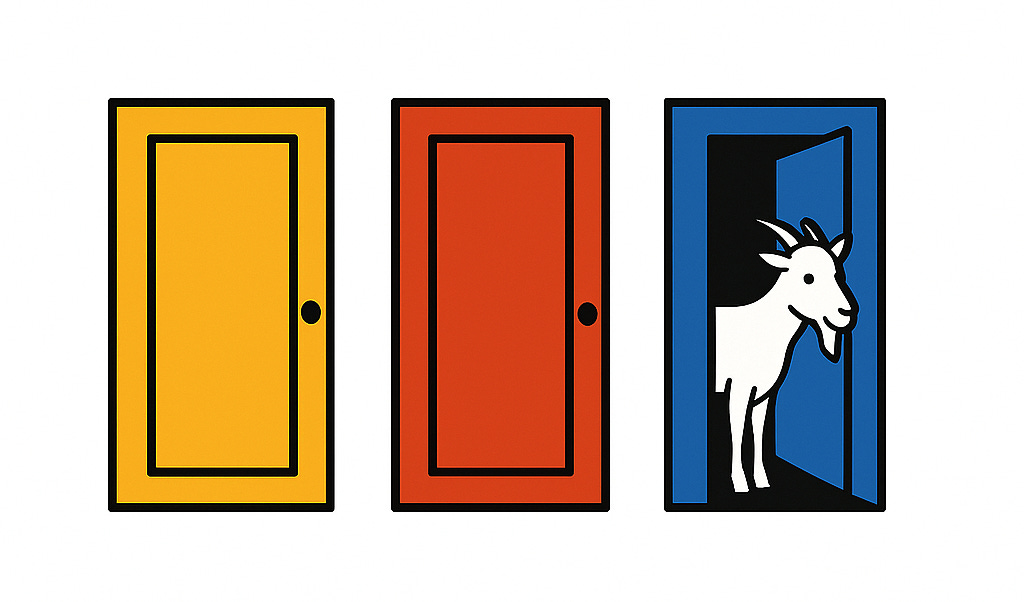
Picture yourself on a television game show set in the 1970s. The lights are blazing, the audience is buzzing, and in front of you stand three colorful doors. Behind one waits the ultimate prize: a shiny new sports car. Behind the other two, bleating goats shift impatiently in their pens.
The host asks you to choose. You point to Door A. The crowd cheers. But instead of revealing your fate, the host strolls over to another door. He knows where the car is, and with theatrical flair he opens Door C to show a goat. The audience laughs. Two doors remain: your Door A and the unopened Door B. The host leans toward you with a smile: “Do you want to stay with your first choice, or switch?”
What do you do?
Solution
At the moment you first picked Door A, you had a one–in–three chance of being right. That means there was a two–in–three chance that the car was behind one of the other doors. When the host opened Door C to reveal a goat, he did not reduce the car’s two–thirds probability and share it equally between A and B. Instead, by deliberately removing one losing option, he effectively concentrated the entire two–thirds chance onto the single unopened door.
In other words, your first choice remains stuck at one–third, while the other unopened door jumps to two–thirds. By switching, you double your odds of winning.
This logic becomes clearer if you imagine the same game played with ten doors instead of three. You pick one door, giving you a one–in–ten chance of success. The host, who knows the prize’s location, then opens eight of the remaining doors, all showing goats. Only two doors are left: yours, still with its one–in–ten chance, and a single unopened door, which now holds the overwhelming nine–in–ten likelihood of concealing the car. In the ten–door version, the advantage of switching is obvious.
A Variant: Monty Fall
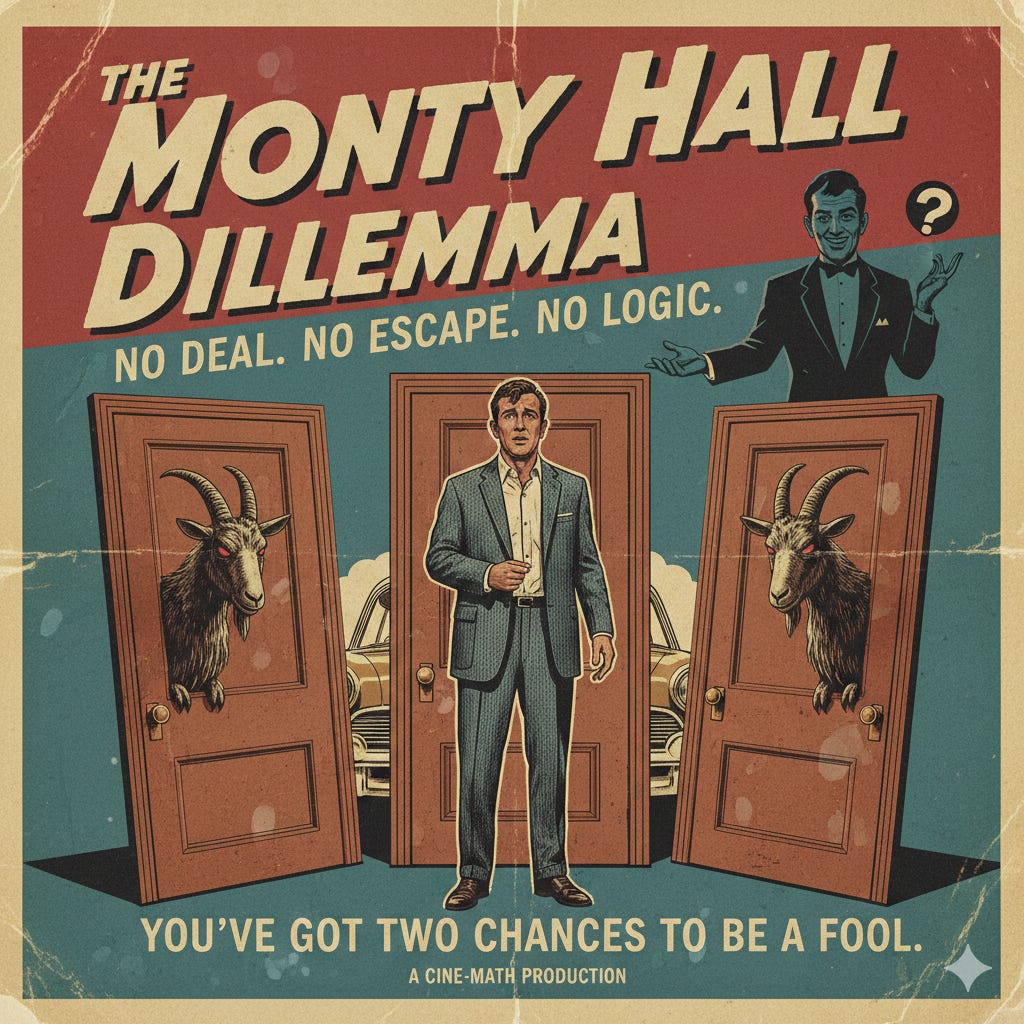
There is a twist sometimes called Monty Fall. Imagine the same setup with three doors, but this time the host is clumsy. He opens one of the other two doors at random. By chance, he happens to reveal a goat. Should you switch now?
The answer changes. Because the host did not deliberately avoid the car, his action provides weaker information. If you condition only on the fact that “a goat was revealed by accident,” the remaining two doors are genuinely equal in probability. In Monty Fall, switching gives you no advantage.
This contrast highlights the essence of the Monty Hall problem: the odds shift because the host’s reveal is selective and knowledge-driven. When the reveal is random, the selection bias disappears, and with it the benefit of switching.
Historical Note
The puzzle takes its name from Monty Hall, the longtime host of the American television game show Let’s Make a Deal, which began airing in the 1960s. Contestants on the show often faced choices between hidden prizes, sometimes switching doors in the hope of trading a dud for something better. The puzzle itself, however, was popularized not on television but in print.
In 1990, columnist Marilyn vos Savant, writing in Parade magazine, received a letter from a reader asking whether it was to a contestant’s advantage to switch doors. Vos Savant explained that switching doubled the odds of winning, from one–third to two–thirds. To her surprise, thousands of letters poured in angrily insisting she was wrong. The controversy spilled into newspapers and classrooms across the country. Eventually, careful demonstrations confirmed her reasoning: switching really is the better choice.
This small episode in popular culture is now one of the best-known examples of how our intuition about probability can fail. What feels like a trivial guessing game turned into a national debate, proving that even trained minds can stumble when conditional probability is at play.
Real-life Implications
The Monty Hall problem is a lesson in conditional probability: when new information arrives, probabilities shift. The key is that the host’s action is not random. He knows where the car is, and he uses that knowledge to choose which door to open. That selectivity is what moves the odds.
The same dynamic appears in hiring. If you pulled a candidate at random from a thousand applicants, your chances of having found the best one would be slim. But a candidate who has survived three rounds of cuts is a different proposition. The elimination process itself is information. The fact that they’re still standing tells you something, just as the host’s deliberate choice of which door to open tells you something. Selective elimination concentrates probability on what remains.
The same filter operates in science. When researchers run a study and find no effect, the result is rarely published as journals favor positive findings, and null results tend to sit in file drawers. So the published literature is not a random sample of all studies conducted. It is a sample of studies that found something.
The publication process, like Monty Hall, is selective. It removes the uninformative outcomes and shows you only the ones that look interesting. What remains appears more convincing than the full picture warrants. A drug with a dozen published studies showing modest benefits may have fifty unpublished studies showing nothing at all, but you only see the dozen. The question to ask of any published finding is the same one to ask of the remaining door: what got removed before I saw this, and who decided to remove it?
Information always arrives through filters. Someone decided what to reveal and what to withhold. Ignoring that is where probabilistic reasoning most often goes wrong.
Take the survey or comment if you have any thoughts on this format: